
Professional Impedance Meter Scale
A professional body composition scale is a medical or fitness devicethat measures body composition with very high precision to provide comprehensive data on body fat, muscle mass, body water, and visceral fat.

Our flagship model—HowBody S580
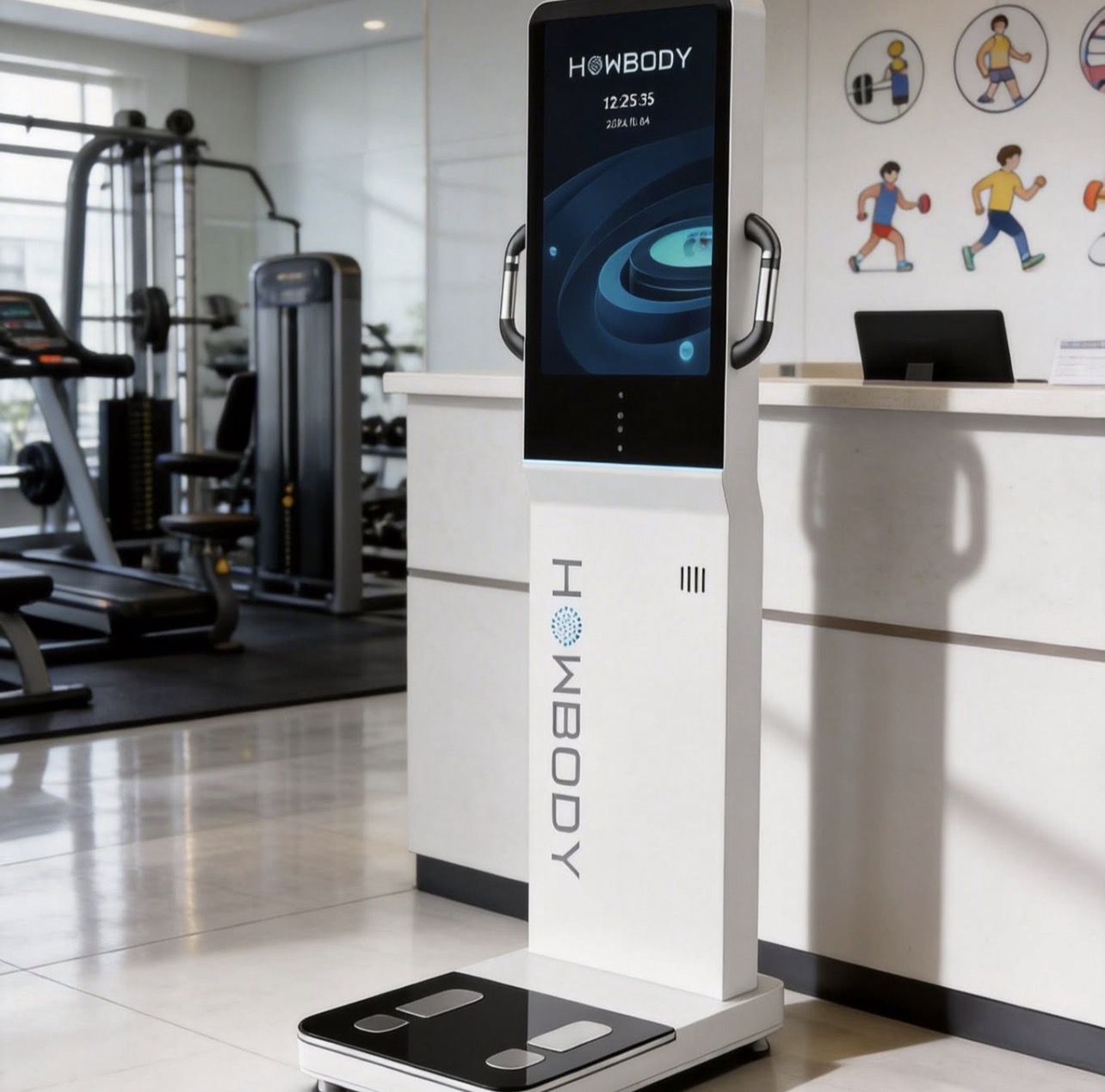
The S580 is currently the flagship model in the HowBody line. It is a vertical touchscreen kiosk with a 27-inch screen, a built-in weighing platform, and a 360° rotating platform for body scans.
It analyzes five segments using bioimpedance and eight using 3D scanning. Each measurement provides 19 health metrics, 9 postural indicators, and 9 circumference measurements, presented in two separate reports.
Three finishes are available—Snow White, Onyx Black, and Titanium Grey—and they can be customized to match the institution’s colors.


What is a professional impedance meter?
A professional body composition analyzer is a device capable of accurately analyzing body composition, such as body fat, muscle mass, visceral fat, and so on.
HowBody uses multi-frequency DSM-BIA technology, also known as multi-frequency bioimpedance analysis, which sends a very low-intensity electrical current through the body via eight electrodes placed on the hands, feet, and torso to analyze these different areas separately.
The detailed body assessment that results from this process enables the professional to guide a client through their fitness journey, body transformation, or rehabilitation using concrete data that goes beyond a standard consultation.
What is a professional impedance scale used for?
A professional bioimpedance scale is used to accurately measure a client’s body composition in order to provide a comprehensive assessment, which a professional uses as the basis for monitoring their clients’ progress.
For professionals, the main benefit is having access to concrete and comparable data from one financial statement to the next that make it possible to:
- To tailor a fitness program,
- To track a physical transformation,
- To support rehabilitation
- To demonstrate progress that isn’t always evident from a simple change in weight.
The data is detailed enough to identify an imbalance between the two legs, track actual muscle gain, or measure fat loss that isn’t visible on a standard scale.


Why is a bioimpedance analyzer essential for sports and health professionals?
Whether you’re a professional in the sports, health, or wellness industry, having a professional bioimpedance scale with built-in 3D scanning capabilities allows you to track changes in the body, tailor your guidance, and make progress visible to the client.
The professional can explain the results, highlight progress, and adjust the program based on the data collected. The client gains a better understanding of their progress and has a concrete reason to continue with the program and return regularly for a follow-up assessment. This can serve as a powerful tool for differentiation and client retention that adds value to your services.
The body composition assessment can thus be included as part of a membership, a treatment plan, or a personalized program, rather than offered as a simple self-service weigh-in. It is a service in its own right that enhances the perceived value of your support.
Why choose a HowBody professional body composition analyzer?
While a conventional impedance meter is limited to body composition, a HowBody impedance scale provides additional data not only on the body’s internal composition but also on body volumes, circumferences, shapes, and dimensions.
Comprehensive segmental body measurements combined with 3D scanning
Body composition analysis provides a detailed assessment of body composition, including measurements of body fat, muscle mass, body water, visceral fat, BMI, and waist-to-hip ratio.
While the 3D scan and postural assessment show what the body looks like from the outside to identify asymmetries, imbalances between the right and left sides, and any tilts or rotations of the body.
HowBody combines this complementary data—which provides a comprehensive view of the individual—into a single device by integrating multifrequency segmental bioimpedance analysis with 3D scanning.


Complete technical transparency
HowBody publishes the full specifications of its devices so you know exactly what the device measures and how it measures it:
- The measurement method,
- The number of electrodes,
- Frequencies
- The segments analyzed.
Each device is calibrated against a common standard to ensure measurement consistency. This allows results obtained from the same client, using the same device, and under comparable conditions to be reliably tracked and compared over time.

Make invisible progress visible
Making invisible progress visible with numbers your customers can understand—that’s the HowBody product signature.
Each exam generates two reports—one on body composition and one on posture —with information that is immediately clear and easy to understand:
- An easy-to-understand overall score.
- A 3D avatar shown from four angles—front, back, left profile, and right profile—accompanied by an evaluation and related advice.
- A historical comparison that tracks successive tests and shows changes in weight, body fat percentage, and muscle mass.
- A QR code printed on the report that allows you to view your results on your smartphone

A Long-Term Commitment to Quality
- All HowBody professional devices come with a 2-year warranty and include lifetime support and updates.
- Delivery is included in the price. Our teams also assist with assembly and setup, ensuring that the equipment is ready for use as soon as it arrives at your facility.
- Thanks to the option to lease, this investment is converted into a monthly expense, and an independent gym can acquire a professional impedance meter without tying up its cash flow.
- For multi-location chains, we offer customization of the hardware and software to match your brand colors for orders of five units or more.

How to Choose the Right Professional Body Composition Scale
Turn a metric into an experience to better track your customers.
The number of measurement intervals
The more frequencies a device measures, the more accurately it can analyze the distribution of water in the body, particularly inside and outside cells. In fact, a multi-frequency impedance meter (e.g., 5, 50, 250 kHz) is more accurate than a single-frequency one because it can better distinguish between intracellular and extracellular water.
Software and Long-Term Monitoring
The professional value of an impedance meter lies in its ability to track changes over time, allowing each test to be recorded automatically, maintaining the client’s history, and comparing new data with previous measurements. Ideally, this history should be accessible remotely, and clients should be able to view their own results from their personal account.
Data Hosting and the GDPR
Body data is considered sensitive personal data. Check where it is hosted and under what legal framework. HowBody data is hosted on cloud servers located in the European Union, with processing that complies with the GDPR and a guest mode that allows users to track their data without creating a profile.
Warranty and Support
The warranty period is important, but so are technical support and software updates, because a device used daily at a gym needs ongoing support over the long term. Be sure to check the terms of coverage in the event of a breakdown, response times, the availability of replacement parts, and the option for remote diagnostics.
Integration into your space
The kiosk will be visible to your members and customers, so it plays a role in how your offerings are perceived, just like your machines. Be sure to check the design, footprint, and finish, as these are also part of the experience.

Frequently Asked Questions
What is the difference between a consumer-grade and a professional-grade impedance scale?
A consumer-grade scale typically uses two electrodes and a single frequency, and it provides a general estimate of body composition based on the lower body. A professional body composition analyzer like HowBody measures using eight electrodes and four frequencies, segment by segment, and generates detailed reports that can be used for professional monitoring.
Are the measurements reliable?
Yes, because segment-by-segment analysis using DSM-BIA technology minimizes estimates, allowing for a precise assessment of each area of the body. Thanks to this technology, the results are reproducible; that is, when measurements are taken under similar conditions—for example, at the same time of day and with a comparable level of hydration—the variations observed from one test to the next more accurately reflect the client’s progress.
Is it possible to finance the purchase of a professional impedance meter?
Yes, HowBody offers leasing financing through its partner Grenke, starting at approximately €290 per month (excluding tax). This option allows you to equip a gym, spa, or practice without tying up cash, and to recoup the cost of the equipment as soon as the first sessions are billed or included in membership fees.
How much space should be set aside for this type of appliance?
The station consists of a column with a built-in weighing platform and a separate rotating turntable, which is required for 3D scanning. Ensure there is sufficient clearance around the turntable to allow for full rotation. The device operates between 10 and 40 °C using a standard AC power supply.
The unit has a footprint of 181 cm long by 68 cm wide. In addition, a minimum clearance of 30 cm is required on each side, as well as 1 m behind the turntable.
What can be measured on a professional impedance meter?
The devices are designed to assess individuals aged 10 to 99, with a height between 70 and 200 cm and a weight of up to 220 kg. As with any bioimpedance device, use is not recommended for individuals with active electronic implants or during pregnancy.
Let's talk about your project
A HowBody representative will call you back to help you determine the solution that best fits your organization.